domenica 20 maggio 2007

Monde Animal

Monde Animal au Moyen Age
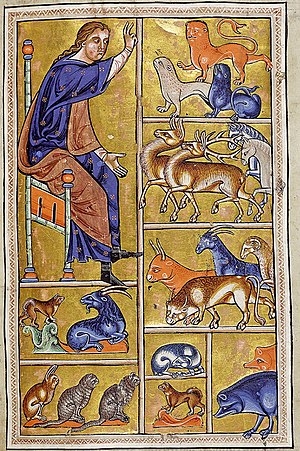
Contrairement à ce que l'on peut constater dans les études médiévales, où le monde animal constitue un grand sujet et donne lieu à toute une série de publications, la Toile ne retient guère que peu de sites offrant un éclairage bien défini sur le sujet, en matière de contenu et d'approfondissement. La plupart des sites rencontrés offrent avant tout une collecte d'enluminures où le monde animal a sa place.
visitez le site:
http://www.ext.upmc.fr/urfist/menestrel/medanimal.htm

venerdì 18 maggio 2007

JORNADA FRANCISCANISME, ESTAT I SOCIETAT A LA CORONA D’ARAGO (SEGLES XIII-XV)
21 de maig de 2007

16:00 Manuel Sanchez (Institucio Mila i Fontanals, CSIC) L’elit itinerant franciscana a la Corona d’Aragon
16:45 Paolo Evangelisti (Universita di Trieste) Identitat comunitaria, monarquia i Estat: conceptes i projectes politics dels franciscans
17:30 Pausa - Cafe
17:45 Jaume Mensa (Universitat Autonoma de Barcelona) Arnau de Vilanova i els beguins. Una nova espiritualitat medieval
18:30 Xavier Renedo (Universitat de Girona) Filosofi a i etica politica en els teorics del mon francisca: el cas de Francesc Eiximenis Coordinacio: Manuel Sanchez (Institucio Mila i Fontanals)
Residencia d’Investigadors CSIC-Generalitat de Catalunya, carrer Hospital 64 Tel. 93 443 27 59 |
vai al sito
www.residencia-investigadors.es

Medieval Gardens

Medieval Gardens
In medieval times, a garden could have a symbolic and spiritual dimension. The hortus conclusus or 'enclosed garden' was a sacred area which might represent the Christian soul, enclosed in the body, or the Church, formed of the body of the faithful. It was also, in the late Middle Ages, an image of the Blessed Virgin Mary, identified with the bride in the Song of Songs in the Old Testament. In the 15th century, depictions of the Virgin in a Paradise Garden were frequent, in particular in Flemish and German painting. In these images, the flowers all have a symbolic meaning, representing Mary's virtues.
By growing these flowers outside our own church dedicated to St Mary, we have created an area of colour and interest, and also linked ourselves with the medieval inhabitants of Shoreham, who would have understood very well the spiritual significance of these lovely plants.
go to the site:
www.stmarydehaura.org.uk/gardens.html

giovedì 17 maggio 2007

La cuisine au Moyen Age

La cuisine au Moyen Age
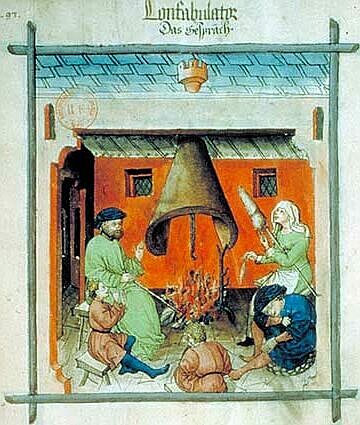
achez tout d'abord que les ouvrages qui abordent ce qui entretien la vie, ce qui a trait aux vivres, sont dénommés « viandiers ». Le viandier est l'ancêtre de notre actuel livre de cuisine. Si bon nombre de viandiers furent écrits dans le plus total anonymat, certains ouvrages signés sont aujourd'hui forts célèbres. On parle ainsi très souvent du « Viandier » de GUILLAUME TIREL alias TAILLEVENT, cuisinier des rois Philippe de Valois, Charles V et Charles VI. Dans l'ensemble, on peut dire que la plupart des ouvrages traitant du sujet furent rédigés au XIVe et XVe siècle. Ne vous méprenez pas sur le terme « viandier », ce n'est pas un ouvrage qui parle uniquement de viande... En fait, au Moyen-âge, on désignait plutôt la viande par le mot « chair ». A propos de chair, imaginez un peu qu'au Moyen-âge, l'église imposait de ne manger ni viande ni graisse animale les vendredi et samedi de chaque semaine... Ajoutez à cela des périodes de jeûne comme celle du carême qui démarrait 40 jours avant Pâques... et vous obtenez en gros 150 jours dans l'année où l'église interdisait de toucher à de la viande ou à des dérivés... Même le lait était interdit, on le remplaçait alors par du lait d'amande, très digeste et permettant des liaisons extrêmement onctueuses.
L'article présent va surtout parler de la cuisine des seigneurs et de la petite noblesse. Je n'aborderai pas, tout du moins pour le moment, les repas gargantuesques qui pouvaient se dérouler à l'époque... Mettons donc de côté, les repas de noces, de banquets...etc. Je sais... vous rêviez de rôtir à la broche un veau entier farci de volailles mais bon ;-).
visitez le site:
perso.orange.fr/parchemin/cuisine.htm


mercoledì 16 maggio 2007

Medieval Greece

Medieval Greece
The history of the medieval period in Greece is extremely confusing. With the power of the Byzantine Empire partially broken and in rapid decline various foreign and Greek groups fought to control localised fiefdoms. It is not my intention to even attempt to put together any sort of synopsis - other writers have done much better than I could. Hetherington has as clear an overview as is possible in the early part of his Byzantine & Medieval Greece, Cheetham's Medieval Greece is a good longer academic narrative and Lock's The Franks in the Aegean is an excellent contemporary take on the period and has a useful chronology.
In the mid to late middle ages a mixture of Franks (basically French - but often a long time wandering around the Mediterranean), Italians - primarily Venetians, Pisans and Genoese - and Catalans all made their historical mark on Greece. However the underlying Greek speaking populace remained pretty constant and these conquerors and rulers have left little trace of their occupation save the medieval castles which dot the hilltops and the extremely rare examples of gothic features in churches. Of Frankish culture it is hard to find any traces whatsoever such was the hold of the Orthodox Church on the imaginative horizons of the population. One caveat - to talk of nation states in the medieval period is to project and impose modern ideologies and cultural and ethnic preconceptions back into a past where they would not be recognised.
go to the site:
www.zorbas.de/maniguide/medieval.html


martedì 15 maggio 2007

Early Medieval China

Early Medieval China
Early Medieval China is a journal devoted to academic scholarship relating to the period roughly between the end of the Han and beginning of the Tang eras. Boundaries in historical time are rarely abrupt or sharp, so the journal's coverage is, at times, extended in either direction. The focus, though, remains on the people, events, and culture of the years 220-589 A.D.
go to the site:
http://web.aall.ufl.edu/EMC/

lunedì 14 maggio 2007

Medieval reenacment

Rosa Mundi Medieval Reenacment Society
Rosa Mundi is a mediaeval re-enactment society which is based in Redcar, Cleveland.
The society specialises in life in the last quarter of the fifteenth century. Very many different aspects of fifteenth century life, military and non-military, are re-enacted. At a Rosa Mundi event you may expect to see some or all of the following:
-Life in medieval camp or in a castle
-Cordwainers, Shoe repairing
-Knife makers and sharpeners
-Medieval games, music and dancing
-Cooking and life in kitchen
-Gentry leisure and servants at works
go to the site:
www.dur.ac.uk/b.m.hodgson/rosamundi/

martedì 1 maggio 2007

Medieval music

Medieval Music
Medieval music was an integral part of everyday life for the people of that time period. Music of the Middle Ages was especially popular during times of celebration and festivities.Music was often played during holidays and special parties. During weddings and birthdays, the music was especially uplifting. For weddings and on Valentine's Day, lovers' music was played that was sure to evoke a romantic atmosphere. This type of music was called "chivaree." The musicians would play buoyant and cheery music with crescendos. Many a different Medieval music instrument was played, including, recorders, horns, trumpets, whistles, bells, and drums.On Mayday, dancers would dance to specially-prepared, high-pitched music. It was believed that by doing so, the hibernating spirits would be awakened and forewarned that spring had arrived.
go to the site
www.medieval-life.net/music.htm