The year was 1095 CE, William the Conqueror had united England under one crown 30 years earlier.* The French had been dividing properties amongst their sons for generations, causing bloodshed between brothers over small pieces of real estate. In reaction, Pope Urban II expanded "The Truce of God", which outlawed fighting from Sunday to Wednesday, and banned fighting involving priests, monks, women, laborers and merchants on any day of the week. Italy was a collection of city-states, constantly being overrun by invading hordes, the latest of which were the Normans, who had just started to become "civilized".
There was also the Byzantine empire, ruling from Constantinople, whose emperor at this time was Alexius Comnenus. To his East, the Turks were rapidly encroaching on his empire, and had begun attacking pilgrims on their way to - and in - Jerusalem, causing him great distress. He wrote to his friend Robert, the Count of Flanders, in 1093, telling him about supposed atrocities committed by the Turks on the Christian pilgrims, and Robert passed this letter on to Pope Urban II. Urban, an opportunist, saw this as a perfect way to solve some of his local problems. He personally promoted a Holy Crusade to reclaim the Holy Lands from the barbarian Turks. Thus, the First Crusade was launched in 1096 CE
.http://www.medievalcrusades.com/
lunedì 14 aprile 2008
Medieval Jerusalem
martedì 8 aprile 2008
Medieval writings
Welcome to new users of this site, and welcome back to those returning for another look. This constantly growing project revolves around the culture of the written word in the middle ages. There is information on what people wrote about, as well as what they didn't write about but evidently knew anyway, some discussions on the working methods and materials of writing and concepts of literacy, and a steadily growing set of examples of historic scripts from around the 5th to around the 16th century. That is a broad chronology for medieval, but is there to demonstrate certain continuities in the culture and practice of writing. There are interactive paleography exercises derived from writing samples either in my possession or that of others or in archival institutions. Some examples have been published in very ancient paleography books that represent the finest of scholarship but which unfortunately nobody seems to read any more. The others have been nutted out by the partnership we call Tillotson's Medieval Enterprises, which means the interpretations may not be so authoritative, but you may not find them anywhere else. The project continues to grow, so bookmark the site so that you can return at leisure to explore around it.
http://medievalwriting.50megs.com/writing.htm
lunedì 7 aprile 2008
St. Francis bibliography
http://moses.creighton.edu/harmless/bibliographies_for_theology/Medieval_5.htm
domenica 6 aprile 2008
Medieval German Literature
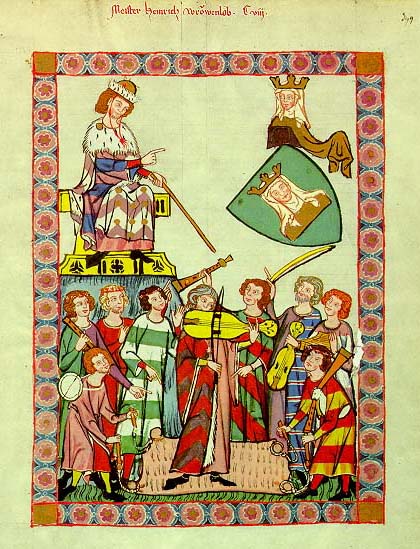
The literature of any culture may be said to begin a long time before its first extant works were written down in manuscript form; the earliest manuscripts of German literature extend back to the eighth century. We can be sure of this because there exist in other Germanic languages, notably Gothic, Old English, and Old Norse, similar works that clearly belong to a common Germanic tradition. The events they recount, so far as they are historical, took place during the «Völkerwanderung», the mass-movement of Germanic peoples (375-568), that is, before the Germanic tribes split into the people we now designate as German, Scandinavian, and Anglo-Saxon. There can be no doubt that these troubled times gave impulse to creating songs, sagas, and legends, and that singers and poets?often summarily referred to as ´skopsª?gave them artistic form. Historical events were interwoven with mythological elements and motifs from other cultures, but there is a great deal of material common to all the Germanic literatures. It should be noted in this context that the appearance of any literature of note was contingent upon the de facto, if only superficial, incorporation of the Germanic tribes into the Church (DeBoor). It was during this early period that there developed the peculiar form known as alliterative poetry or «Stabreimdichtung», whose characteristics are the use of regular alliteration of stressed syllables and a four-beat line, associated in Norse poetry with the poetical device of kennings or descriptive periphrases of nouns.Although we are aware of the existence of this body of oral poetry and can trace its influence on works that are extant, it is risky to attempt to reconstruct Germanic works or to posit a «Germanic hero» type, in the sense that such heroes are supposedly endowed with qualities not found in other literatures. In fact, the heroes of Germanic works, so far as we can determine, share many of their characteristics with early heroes of other cultures. Nevertheless, they do possess some distinguishing moral and social values which will be considered later.
Medieval literature in Germany is generally divided into Old High German, early Middle High German, the classical period of Middle High German literature, and later Middle High German Literature, often also including earliest New High German Literature. The first of these divisions, which covers the period from about 775 to about 1075, is more of a linguistic than a literary division. It actually includes works written in several dialects, and one of the most important poems of the period, the Heliand, is written in Old Low German (that is, Old Saxon). The second period encompasses widely divergent literary monuments of the late eleventh and early twelfth centuries. The classical period, during which almost all the outstanding works of medieval German literature were written, ex-tends from about 1170 to 1230. Its important cultural and literary characteristics are clearly
Introduction
mercoledì 2 aprile 2008
Strange Bayeux
http://medievalwonka.ytmnd.com/
http://medievaljumparound.ytmnd.com/
http://yeoldebookstorecrash.ytmnd.com/
martedì 1 aprile 2008
Medieval Travel
The all new medieval travel site, come travel back in time, when knights were bold and Camelot was not the
name of a national lottery company.
Medieval travel contains information on medieval times, medieval castles, medieval armour, medieval weapon, medieval knight, medieval clothing, medieval costume, medieval times.
Medieval restaurant, medieval dress, medieval sword, medieval art, medieval food, medieval music, medieval history, medieval shields, medieval game, medieval clothes
sabato 29 marzo 2008
Medieval Cyberspace
In an ancient, rotting dungeon, the group edges forward toward the next room. The leader, speaking into a microphone attached to his PC, tells the other members to be careful. His character then walks to a switch and activates it, opening the door to the next room. Without warning, a group of skeletal warriors filters into the room. The party falls back, organizing itself amid the chaos. The warriors fight; the healers take care of the injured and other magic classes target enemies with spells from a safe distance.Welcome to Dungeons and Dragons Online: Stormreach, an MMORPG (Massively Multiplayer Online Role-Playing Game) adaptation of the classic Dungeons and Dragons tabletop game series. Developed by Turbine (http:/
Medieval Cyberspaces
Iscriviti a:
Post (Atom)