venerdì 31 agosto 2007
Marriage during the Middle Ages
Weddings during medieval times saw the origin of several modern traditions and customs. There was more to the Middle Ages than just castles, chivalry, and fancy colours. It was a time of developement for many social and marriage customs followed by brides today. This era between the fall of the Roman Empire and the Reformation was unique and through it all, faith was the ever-present catalyst for artistic, intellectual, social, and political developments. Medieval marriage was still the province of the Church, and the sacrament of matrimony was central to Christian doctrine. Grooms, on the average, were much older than their brides. Noble women sometimes didn't marry until the age of 24, but this was rare. More than 3/4 were married before they reached 19. By today's standards, western Europe was inhabited by the young, with more than half of the population under 20 years of age. http://www.medieval-weddings.net/
martedì 28 agosto 2007
Medieval Cakes
The center part (minus the turnable page) for my 65th birthday cake. Borders copy one from a medieval page along with my arms and the SCA symbol for the Order of the Rose. The arms and rose are on rice paper and painted with paste food colors. Left hand text is a "bastard" mixture of Latin, English and Spanish. Right hand page is a copy of text from a 16th century book of manners. Writing is done with a number 1 tip.
giovedì 23 agosto 2007
Medieval clocks
The Egyptians were big on sundials. The Chinese favored water clocks. In the early Middle Ages, time was first marked down the length of a candle in hourly increments. Next came large hour glasses, which were only good for an hour...or two.
Then, Brother Gerbert, who later became Pope Sylvester II, invented a simple mechanism in 966 that rang bells at regular intervals throughout the day to call his brethren to prayer. It was the beginning of mechanical clocks as we know them today.
Soon, cathedral towers were providing the rest of the faithful with their first glimpse of a right proper (although not always accurate) mechanical clock.
The earliest of these is credited to Jacopo de Dondi, who designed an astronomical clock for the cathedral tower in Padua in 1344. Curiously, almost every zodiac sign surrounds the clock face except for the balanced scales of Libra. (As the story goes, it was deliberately left out of the lineup by guild workers who felt they weren't treated fairly in salary negotiations.)
Strasbourg Cathedral's mechancial clock appeared in 1354, and was followed by the third, and most elaborate mechanical clock, built in Prague's Town Hall in 1410.
This being the Middle Ages, the Prague clock depicted earth at the center of the universe - with the sun, moon, and stars revolving around it. Blue and red halves separated day and night. With embellishments added over the centuries, today the clock remains a veritable funhouse of timekeeping.
Then, Brother Gerbert, who later became Pope Sylvester II, invented a simple mechanism in 966 that rang bells at regular intervals throughout the day to call his brethren to prayer. It was the beginning of mechanical clocks as we know them today.
Soon, cathedral towers were providing the rest of the faithful with their first glimpse of a right proper (although not always accurate) mechanical clock.
The earliest of these is credited to Jacopo de Dondi, who designed an astronomical clock for the cathedral tower in Padua in 1344. Curiously, almost every zodiac sign surrounds the clock face except for the balanced scales of Libra. (As the story goes, it was deliberately left out of the lineup by guild workers who felt they weren't treated fairly in salary negotiations.)
Strasbourg Cathedral's mechancial clock appeared in 1354, and was followed by the third, and most elaborate mechanical clock, built in Prague's Town Hall in 1410.
This being the Middle Ages, the Prague clock depicted earth at the center of the universe - with the sun, moon, and stars revolving around it. Blue and red halves separated day and night. With embellishments added over the centuries, today the clock remains a veritable funhouse of timekeeping.
sabato 18 agosto 2007
Saintes et travesties du Moyen Âge
Recluses, ermites ou engagées dans le monde, les saintes travesties sont nombreuses jusqu’à la fin du Moyen Âge. Ayant valeur de transgression et/ou d’initiation, le travestissement permet à Thècle, Pélagie, Marguerite, Marine ou Eugénie de redéfinir non seulement la notion de virginité mais d’affirmer une sainteté au nom d’une intégrité qui dérange les catégories sexuées et renverse les notions de genre. D’autres, comme Galla, Paula ou Wilgeforte, délivrent de l’antagonisme des sexes. Et toutes, jusqu’à Jeanne d’Arc, bouleversent la destinée des femmes en perturbant l’ordre temporel des hommes. Ainsi apparaît la conquête d’un nouveau corps à travers la mission chrétienne et l’expérience mystique, qui déjoue la nature de femme et les vertus masculines. Vai al sito: http://clio.revues.org/document253.html
giovedì 16 agosto 2007
Medieval ships
In May 1990 a wreck of an unknown ship was discovered in the course of the dredging of the left bank of the
Pärnu River by a newly built pier of the yacht club. The wreck lay embedded under a 30-40 cm layer of mud at the depth of 1.5 m of water. Before dredging was stopped temporarily, a certain amount of fragments of the ship's planks and ribs were taken ashore by an excavator.On May 24, 1990, a preliminary inspection of the wreck site was carried out by the researchers of the Estonian Maritime Museum . Having seen that the ship's wood was black oak, the researchers decided that the find would need most serious attention and detailed investigation, so the digging of the river bottom could not be continued.In July a thoroughgoing research of the wreck was made. The site of the object was explored by means of iron rods and the measurements of the find were ascertained.
go to the site:
http://www.abc.se/~pa/publ/paernu.htm
Pärnu River by a newly built pier of the yacht club. The wreck lay embedded under a 30-40 cm layer of mud at the depth of 1.5 m of water. Before dredging was stopped temporarily, a certain amount of fragments of the ship's planks and ribs were taken ashore by an excavator.On May 24, 1990, a preliminary inspection of the wreck site was carried out by the researchers of the Estonian Maritime Museum . Having seen that the ship's wood was black oak, the researchers decided that the find would need most serious attention and detailed investigation, so the digging of the river bottom could not be continued.In July a thoroughgoing research of the wreck was made. The site of the object was explored by means of iron rods and the measurements of the find were ascertained.
go to the site:
http://www.abc.se/~pa/publ/paernu.htm
sabato 11 agosto 2007
Castilian Medieval Theatre
This guide to castilian theater will ignore a theory asserting that dramatic activity never existed in Castile. Play of the Three Magic Kings is much more than an exception coming from Europe. It proofs the existence of a steady castilian dramatic tradition.
Things have changed after discovering of new texts and a comparative study of our theater inside a romanic context. Indeed finding of lost plays is always possible and can modify our present point of view.
Anyway, we still ignore wich were the literary works devoted to scene and wich were texts for an animated reading.
Tradition has chosen between the canon of possible texts, those that could be performed or not. We respect the scholar's authority when we introduce this exposition of medieval theatre, but we point out to the provisional nature of our view. Scholar authority let us go beyond the limits of year 1500: we stablish 1513 for medieval theater and 16th century for derivations of La Celestina.
We cannot even assert many things on performance of our masterwork, the Tragicomedy of Calisto and Melibea. These pages will be no more than a guiding introduction.
go to the site
www.spanisharts.com/books/literature/i_tecasmed.htm
Things have changed after discovering of new texts and a comparative study of our theater inside a romanic context. Indeed finding of lost plays is always possible and can modify our present point of view.
Anyway, we still ignore wich were the literary works devoted to scene and wich were texts for an animated reading.
Tradition has chosen between the canon of possible texts, those that could be performed or not. We respect the scholar's authority when we introduce this exposition of medieval theatre, but we point out to the provisional nature of our view. Scholar authority let us go beyond the limits of year 1500: we stablish 1513 for medieval theater and 16th century for derivations of La Celestina.
We cannot even assert many things on performance of our masterwork, the Tragicomedy of Calisto and Melibea. These pages will be no more than a guiding introduction.
go to the site
www.spanisharts.com/books/literature/i_tecasmed.htm
mercoledì 8 agosto 2007
Manuscrits médiévaux
Ce texte est une version aménagée du second volume de ma thèse intitulée Livres manuscrits et librairies dans les abbayes et les chapitres vosgiens des origines au XVIe siècle, thèse de doctorat en histoire médiévale de l'Université de Nancy 2, préparée sous la direction de Michel Parisse et soutenue en 1989 (2 vol., 752 p. + pl.).
Le premier volume, édité par les Presses Universitaires de Nancy, en 1992, dans la collection Lorraine, sous le titre Les livres dans les abbayes vosgiennes du Moyen Age, présente l'histoire des abbayes vosgiennes et de leurs livres, autour de la fabrication et de l'entretien des livres, de l'office et de la méditation, des études, de la vie littéraire, des librairies et des grands événements qui désorganisèrent celles-ci.
visitez le site:
http://www.univ-nancy2.fr/MOYENAGE/ArtemTravauxenLigne/TheseMJGG/index.htm
Ce texte est une version aménagée du second volume de ma thèse intitulée Livres manuscrits et librairies dans les abbayes et les chapitres vosgiens des origines au XVIe siècle, thèse de doctorat en histoire médiévale de l'Université de Nancy 2, préparée sous la direction de Michel Parisse et soutenue en 1989 (2 vol., 752 p. + pl.).
Le premier volume, édité par les Presses Universitaires de Nancy, en 1992, dans la collection Lorraine, sous le titre Les livres dans les abbayes vosgiennes du Moyen Age, présente l'histoire des abbayes vosgiennes et de leurs livres, autour de la fabrication et de l'entretien des livres, de l'office et de la méditation, des études, de la vie littéraire, des librairies et des grands événements qui désorganisèrent celles-ci.
visitez le site:
http://www.univ-nancy2.fr/MOYENAGE/ArtemTravauxenLigne/TheseMJGG/index.htm
martedì 7 agosto 2007
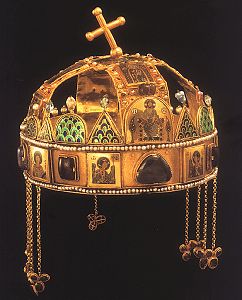
Art in medieval Hungary
This site serves as an introductory research guide to the art of the medieval kingdom of Hungary. The kingdom, founded in 1000 AD, covered a much larger territory than modern Hungary, and included areas such as present-day Slovakia, Transylvania (today in Romania), as well as Croatia. The kingdom reached its peak during the 14th and 15th centuries, under rulers from the Angevin, Luxemburg and Hunyadi families, but essentially collapsed during the Turkish attacks of the early 16th century.
The site contains information primarily about the art of medieval Hungary, but the topic is framed in a larger Central-European context, with links to sites dealing with the medieval art of Bohemia, Poland and Austria as well. The main goals of this page at the moment are to provide an up to date list of publications about the region's medieval art and provide fresh information about medieval art in Hungary, as well as to collect useful Internet links.
go to the site
http://home.hu.inter.net/~jekely/
Iscriviti a:
Post (Atom)