martedì 1 dicembre 2009
Nasce il Centro studi europeo di musica medievale
venerdì 9 ottobre 2009
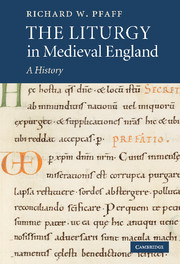
THE LITURGY IN MEDIEVAL ENGLAND
by Richard W. Pfaff
622 pages
Published September 2009
This is the first comprehensive historical treatment of the Latin liturgy in medieval England. Richard Pfaff constructs a history of the worship carried out in churches - cathedral, monastic, or parish - primarily through the surviving manuscripts of service books, and sets this within the context of the wider political, ecclesiastical, and cultural history of the period. The main focus is on the mass and daily office, treated both chronologically and by type, the liturgies of each religious order and each secular ‘use’ being studied individually. Furthermore, hagiographical and historiographical themes - respectively, which saints are prominent in a given witness and how the labors of scholars over the last century and a half have both furthered and, in some cases, impeded our understandings - are explored throughout. The book thus provides both a narrative account and a reference tool of permanent value.
CONTENTS
1. Introduction; 2. Early Anglo-Saxon England: a partly traceable story; 3. Later Anglo-Saxon: liturgy for England; 4. The Norman conquest: cross fertilizations; 5. Monastic liturgy, 1100-1215; 6. Benedictine liturgy after 1215; 7. Other monastic orders; 8. The non-monastic religious orders: canons regular; 9. The non-monastic religious orders: friars; 10. Old Sarum: the beginnings of Sarum use; 11. New Sarum and the spread of Sarum use; 12. Exeter: the fullness of secular liturgy; 13. Southern England: final Sarum use; 14. Regional uses and local variety; 15. Towards the end of the story.
www.cambridge.org/uk/catalogue/catalogue.asp?isbn=9780521808477
lunedì 14 settembre 2009
Los espacios de sociabilidad en el mundo medieval
Valladolid, 5-6-7 de octubre de 2009
Lugar de Celebración: Salón de Grados de la Facultad de Filosofía y Letras de la Universidad de Valladolid
Fecha: 5, 6 y 7 de octubre de 2009
Coordinación: Mª Isabel del Val y Juan Carlos Martín Cea
LUNES, 5 DE OCTUBRE
9.30h. Acreditación de los asistentes y entrega de la documentación y del material de trabajo.
10’00h. Presentación de la reunión científica
Presidente de la Sesión: Dr. D. Juan Carlos MARTÍN CEA
10’30h
La ciudad medieval: entre la ciudad ‘ideal’ y la ciudad ‘real’.
Dr. D. Juan A. BONACHÍA HERNANDO (Universidad de Valladolid)
11’00h.
El mercado como lugar de sociabilidad en las ciudades de Castilla en el siglo XV.
Dra. Dª María Isabel DEL VAL VALDIVIESO (Universidad de Valladolid)
12’00h.
The public life of the City in Late Medieval England. Sociability and urban space.
Dr. D. Christian LIDDY (University of Durham, UK)
12’30h.
Entre la mesa y el mercado: el intercambio comercial como mecanismo de sociabilidad.
D. David CARVAJAL DE LA VEGA (Universidad de Valladolid).
Presidenta de la Sesión: Dra. Dª. Olatz VILLANUEVA ZUBIZARRETA
17’00h.
La sociabilidad en el País Vasco en la Edad Media.
Dra. Dª Beatriz ARÍZAGA BOLUMBURU (Universidad de Cantabria)
17’30h.
Los espacios de sociabilidad del Común en las Cuatro Villas de la Costa de la Mar (siglos XIV y XV).
Dr. D. Jesús SOLÓRZANO TELECHEA (Universidad de Cantabria)
18’30h.
Los espacios de sociabilidad militar en los reinos de Castilla y León (siglos
XII - XIII).
Dr. D. Daniel BALOUP (Casa de Velázquez, Madrid)
MARTES, 6 DE OCTUBRE
Presidenta de la Sesión: Dra. Dª. María Isabel DEL VAL VALDIVIESO
10’30h.
La parroquia castellana en la Baja Edad Media: un espacio versátil de sociabilidad.
Dr. D. Juan Carlos MARTIN CEA (Universidad de Valladolid)
11’00h.
La plaza pública, espacio clave de la sociabilidad bajomedieval aragonesa.
Dra. Dª María del Carmen GARCÍA HERRERO (Universidad de Zaragoza)
12’00h.
El deute de parentesco en la Valencia Trecentista. Obligaciones de reciprocidad, socorro y consejo en la sociabilidad urbana bajomedieval.
Dr. D. Rafael NARBONA VIZCAÍNO (Universidad de Valencia)
12’30h.
Salud y muerte en los hospitales medievales.
Dra. Dª. Magdalena SANTO TOMÁS PÉREZ (Universidad de Valladolid)
Presidente de la Sesión: Dr. D. Juan Antonio BONACHÍA HERNANDO
17’00h.
El viaje en el siglo XV: una forma de sociabilidad.
Ldo. D. Pedro MARTÍNEZ GARCÍA (Universität Bayreuth, Alemania)
17’30h.
Los espacios de sociabilidad en el mundo rural castellano, siglos XIV y XV.
Dr. D. H. Rafael OLIVA HERRER (Universidad de Sevilla)
18’30h.
Sociabilidad y sexualidad : espacios y tiempos (Castilla, siglos XIII y XIV).
Dª. Ana Estefanía ORTEGA BAÚN (Universidad de Valladolid)
martedì 28 luglio 2009
The Soldier in later Medieval England: An exciting new AHRC research project
The project has an innovative methodological approach and will be producing an on-line searchable resource for public use of immense value and interest to genealogists as well as social, political and military historians. The project employs two Research Assistants over three years and also includes one Doctoral Research Studentship - all of whom began work on 1st October 2006. The whole team is working on a jointly authored book, conference papers, and articles.
martedì 14 aprile 2009
Instruments pour jouer les musiques du Moyen Age
Web: www.instrumentsmedievaux.org.
mercoledì 4 marzo 2009
Polonia Medievale

http://polskasredniowieczna.blogspot.com/
martedì 24 febbraio 2009
Musée national du Moyen Âge
Les thermes gallo-romains sont l'un des témoignages les plus spectaculaires de l'architecture antique conservé sur le sol de la Gaule. Lutèce se partageait alors en deux ensembles urbains, l'un blotti à l'intérieur de la Cité ; l'autre sur la rive gauche de la Seine (Montagne Sainte-Geneviève). C'est là que se sont développés villas et monuments grandioses : le Forum sous la rue Soufflot, les arènes rue Monge, les thermes du sud rue Gay-Lussac, les thermes de l'est sous le Collège de France et les thermes du nord dits de Cluny.
Les thermes du nord revêtent une importance particulière du fait de leur état de conservation exceptionnel ; la réutilisation pratiquement continue de l'édifice depuis le Moyen Âge en est la cause principale. Les thermes étaient formés de différents espaces, destinés au public ou aux services, et de souterrains. On identifie aisément les trois salles importantes : le frigidarium (salle froide) englobé dans le musée avec sa voûte de 15 m de haut ; un calda à l'ouest bordé par le boulevard Saint-Michel et un autre caldarium au sud à l'angle du boulevard Saint-Michel et de la rue Du Sommerard. Ces deux dernières salles sont en partie ruinées depuis le XVIIIe siècle. Les murs en élévation ont conservé leur structure d'origine qui se singularise par l'emploi de petites pierres carrées séparées à intervalles réguliers de rangs de briques. A l'intérieur, ils étaient recouverts de mosaïque, de marbre ou de peinture. Le frigidarium en conserve des traces. Le fragment de mosaïque aujourd'hui exposé, « un Amour chevauchant un dauphin », pourrait en constituer le dernier vestige. Cet ensemble architectural était comme bien d'autres thermes, l'un des hauts lieux de la civilisation romaine.
Musée national du Moyen Âge - Thermes et hôtel de Cluny
6, place Paul Painlevé
75005 Paris
Website: www.musee-moyenage.fr.
lunedì 16 febbraio 2009
Migration et identité religieuse
Dates: jeudi 05 et vendredi 06 mars 2009
Contact: Daniel König: dkoenig@dhi-paris.fr 8 rue du Parc-Royal 75003 Paris