lunedì 9 giugno 2008

Medieval Moon

Medieval Moon
This site carries fine and fun collectibles with medieval, renaissance, fantasy, science fiction, gothic themes and more. Please click on the navigation links on the left to find the subject you are looking for.
We try to update our products often, but don't hesitate to contact us if you are looking for something in particular that you're not seeing on the site.
www.medievalmoon.net

sabato 7 giugno 2008

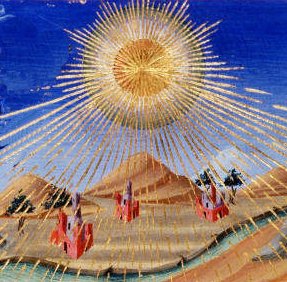
Medieval Sun

Medieval Sun
Back to architecture today. Here we look at the celing of the baptistry in Parma, Emilia-Romagna, Italy. This baptistry is not so often visited by tourists compared with the ones in Florence or Pisa, while it is considered one of the most homogenous medieval monuments in northern Italy. It is a transition work between the Romanesque and Gothic styles and is the vision of one man, Benedetto Antelami. It was built between 1196 and 1270 on an octagonal plan and constructed of pink Verona marble. The baptistry contains an impressive selection of 13th and 14th century frescoes and paintings. The inside is divided into 16 sides rising into 16 niches, with each fresco portraying a biblical scene and surrounded by sculptures representing the months, the seasons and the signs of the zodiac
http://www.trekearth.com/gallery/Europe/Italy/photo399223.htm

venerdì 6 giugno 2008

Medieval Aristotele


Medieval Aristotele
"The centuries between Aristotle and Porphyry bequeathed few logical works to the early Middle Ages. Cicero wrote a Topics, professedly based on Aristotle's work on the subject, but probably derived from a later source. The book was quite widely read in the Middle Ages, at the time when Aristotle's Topics was unknown. A work attributed to Apuleius, and bearing the same Greek title (transliterated) as the De InterpretationePeri hermeneias – enjoyed a certain vogue among the earliest medieval logicians. For modern scholars, it is a useful source of Stoic logical theories; but its philosophical content is slight.

By the time of Porphyry, however, a development had taken place in the status, rather than the doctrine, of Aristotelian logic, which would be of great importance for medieval philosophy. Aristotelian logic had been adopted by the Neoplatonists and given a definite place in their programme of teaching. Whereas their use of Aristotle's philosophical works was piecemeal and distorting, his logic was studied faithfully as a whole. Aristotle had rejected the notion of Platonic Ideas; and he had consequently treated genera and species in his logic purely as class-designations for individual things. The Neoplatonists assimilated this approach, which contradicted the very basis of their metaphysics, by limiting the application of Aristotelian logic to the world of concrete things. Stripped of its metaphysical relevance, the tendency was for logic to become more purely formal than it had been for Aristotle. However, the extra-logical aspects of the Categories and the De interpretatione were too intrinsic to these works to be ignored; and the result was the growth of a body of philosophical discussion and commentary within the Neoplatonic logical tradition, only vaguely related to Neoplatonic metaphysics, and sometimes seemingly antithetical to its principles.

giovedì 5 giugno 2008

Medieval Brain

Medieval Brain
Leonardo da Vinci (1452-1519) made far-reaching contributions in many areas of science, technology and art. Leonardo's pioneering research into the brain led him to make discoveries in neuroanatomy (such as the maxillary antrum) and neurophysiology (he was the first to pith a frog). His injection of hot wax into the brain of an ox provided a cast of the ventricles and represents the first known use of a solidifying medium to define the shape and size of an internal body structure. Leonardo developed an original, mechanistic model of sensory physiology. He undertook his research with the broad goal of providing physical explanations of how the brain processes visual and other sensory input, and integrates that information via the soul.
www.davinciandthebrain.org/brain.jsp

mercoledì 4 giugno 2008

Medieval Night


Medieval Night
The first thing to be said is that The Thousand and One Nights is a rather exceptional work in the context of medieval Arabic literature. It happens sometimes that a person takes up the study of a language because of his love for a single work, but if someone were tempted to begin the task of learning Arabic because of his love of The Thousand and One Nights, he should be forewarned that the book is sui generis. He will really find nothing else like it in the literature, one reason being that the Nights seems to have absorbed a number of once independent medieval Arabic fictions; the story of “Sindbad” is probably the most famous example. The borders of this text were not, it seems, ever very well defined. Hence the size of the Nights. Unfortunately, in the case of the Nights its marginality in this respect has also worked to veil its history in a good deal of obscurity. Indeed, in recounting its history in the medieval period, there is no need to summarize; a fairly complete account will read like a summary, since most of its medieval history is unknown and is likely to remain unknown. To retell the story, let us think of it for the moment as a piece of architecture—a palace, as Borges calls it. “To erect the palace of The Thousand and One Nights, it took generations of men, and those men are our benefactors, as we have inherited this inexhaustible book, this book capable of so much metamorphosis,” Borges said of one of his favorite books
www.arabiannights.org/medieval.html

martedì 3 giugno 2008

Medieval Night

Medieval Night
The first thing to be said is that The Thousand and One Nights is a rather exceptional work in the context of medieval Arabic literature. It happens sometimes that a person takes up the study of a language because of his love for a single work, but if someone were tempted to begin the task of learning Arabic because of his love of The Thousand and One Nights, he should be forewarned that the book is sui generis. He will really find nothing else like it in the literature, one reason being that the Nights seems to have absorbed a number of once independent medieval Arabic fictions; the story of “Sindbad” is probably the most famous example. The borders of this text were not, it seems, ever very well defined. Hence the size of the Nights. Unfortunately, in the case of the Nights its marginality in this respect has also worked to veil its history in a good deal of obscurity. Indeed, in recounting its history in the medieval period, there is no need to summarize; a fairly complete account will read like a summary, since most of its medieval history is unknown and is likely to remain unknown. To retell the story, let us think of it for the moment as a piece of architecture—a palace, as Borges calls it. “To erect the palace of The Thousand and One Nights, it took generations of men, and those men are our benefactors, as we have inherited this inexhaustible book, this book capable of so much metamorphosis,” Borges said of one of his favorite book
www.arabiannights.org/medieval.htm

lunedì 2 giugno 2008

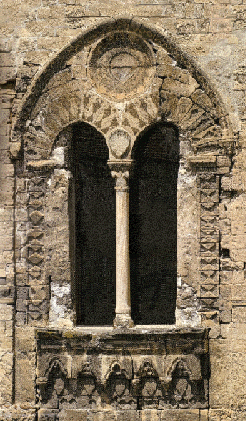
Medieval windows

Medieval windows
ver 400 stained glass panes dating to the 13th and 14th centuries have been preserved in three churches in Esslingen. Practically all the themes found in the sculptural repertoire of the great French Cathedrals of this time are represented, including the Virtues and Vices. Even the everyday life of the citizens of Esslingen is reflected, in scenes from the Life of Mary.The windows give a unique insight into the Medieval world, and into the technical and artistic aspects of the production of stained glass.The central attraction is the windows from the City/Parish church St.Dionysus, made between 1280 and 1330 and recently painstakingly restored. Stained glass windows from the Frauenkirche (Church of our Lady), built by and for the citizens of Esslingen from 1320-1508, and from the choir of the (previously) Franciscan church can also be seen in this Internet exhibition.

Immagini di Medioevo

Immagini di Medioevo
http://www.immaginidistoria.it/epoche1.php?id=1